‹ Home
For businesses & founders

Production AI platforms, scoped and priced before a line is written.

I don't ship demos that break in a week. I build governed, production-grade AI systems for real businesses — and I've turned the build process itself into a deployed product, so the path from idea to shipped is clear, scoped, and priced up front. No agency overhead, no surprises halfway through.

The 2-minute intake wizard is live — it turns "what do you need?" into a scoped, priced plan.

What I build

Five kinds of build, one disciplined backbone.

Every one runs through the same governed pipeline — scoped, gated, and security-tiered to the data it touches.

Business tool

Internal systems that do a real job

A work engine, a dashboard, a connections hub wiring your stack together — the unglamorous software that runs the business.

Personal app

A focused tool for one person's life

Habits, budget, health. Installable, offline-capable, no account to manage.

AI app

An assistant or agent that acts

Something that reasons, routes, and takes action — with the guardrails that keep it honest.

Automation

A workflow that runs itself

Collect, decide, act — on a schedule, with retries and recovery built in. Self-hosted, no per-task fees.

Full SaaS

A complete multi-tenant product

Auth, billing, data model, and the governance to run it in production for real customers.

How we'd start

Two front doors. Pick where you are.

Whether you have a build or just a problem, there's a paid, standalone first step — no commitment to a full engagement to get real value.

Build Clarity · no build yet

Get clear on what to build, before anyone writes code

Discovery → a journey map, a gap register, and a sequenced roadmap, delivered as a clean visual report you own. Sold standalone. It's the difference between building the right thing and discovering the right thing halfway through.

Build Health · you have a build

Audit an existing system, honestly

Front end, back end, and operations: dependency and secret scanning (OSV / EPSS / KEV, Semgrep), intended-vs-actual architecture reconstructed from your git history, and a real health score. A free Health Check earns trust; the paid deep Audit delivers the prioritized fix roadmap.

Every build is security-tiered to the data it touches

T0 Public — standard hardening.   T1 Internal — auth, access control, backups.   T2 Confidential (PII, financials) — encryption at rest and in transit, secrets management, audit logging, least-privilege, isolated infrastructure.   T3 Regulated (health, payments, minors' data) — declined by default; accepted only with insurance, a signed DPA/BAA, and a named human compliance reviewer. Knowing where that line is, and holding it, is part of the work.

Priced with discipline

You see the real iceberg before you commit.

Most builds blow up because the work below the waterline was never scoped. Mine surfaces it up front.

The iceberg, worked

"Just send me a notification."

Above the waterline: one toggle. Below it: a queue, a worker, retries, deduplication, rate-limiting, bounce handling, and CAN-SPAM compliance — roughly 8 backend requirements across 6 systems. You see that iceberg before you sign.

Effort model

Human vs. AI time, by modality

Text, image, video, and RAG work carry rates that differ 10–100×. Effort is split by what AI can actually do versus what a human must — so a video-heavy scope can't quietly blow the estimate.

No loss-leaders

A cost-floor hard-stop

Value-based pricing can never dip below a computed cost floor. The engine refuses to quote a build it would lose money on — so it never under-quotes yours into a corner-cutting job either.

Calibrated

Shadow-mode first

The pricing engine runs against real builds before any client sees an engine-generated number. The price you get is calibrated, not guessed.

LIVE IN PRODUCTION FOR A REAL BUSINESS

NPE AI Gateway.

A full multi-agent platform running in production for a fitness-industry company — the same orchestration backbone as my flagship, applied to a working business: routing client interactions, wiring the company's tools together, and getting real work done with guardrails on. An enforced $250/mo cap across 49 routes and 8 providers proves the cost discipline isn't theoretical.

Orchestration

Multi-agent work engine

A Scrumban work engine where specialist agents pick up, execute, and review tasks through gated stages — with self-healing recovery when something breaks.

Intelligence

Routing & quality control

Bandit model routing, drift and regression detection, and tiered memory — the system picks the right model, catches degradation, and remembers what matters.

Integration

Connections hub

A central hub wiring the business's tools together — Slack, scheduling, call data, project management — so the agents act across the whole stack.

Governance

Compliance gates

Every production action passes a contract, an expert review, and a hard safety gate before it lands. Nothing ships on vibes.

Accountability

ROI economics

Each task carries its AI cost versus a role-matched human baseline — often a 1,000× advantage on well-scoped work.

Reliability

Self-healing operations

Failures become teach-back lessons that stop the same problem recurring — the platform gets more dependable the longer it runs.

DEPLOYED PRODUCT

The build engine is itself a deployed product.

A voice-first intake wizard, an auto-scoping and auto-pricing core, a private component registry, and a Command Center dashboard — running in production. It takes an idea to a priced, architected plan before anyone writes code.

studio.aiedge — intake
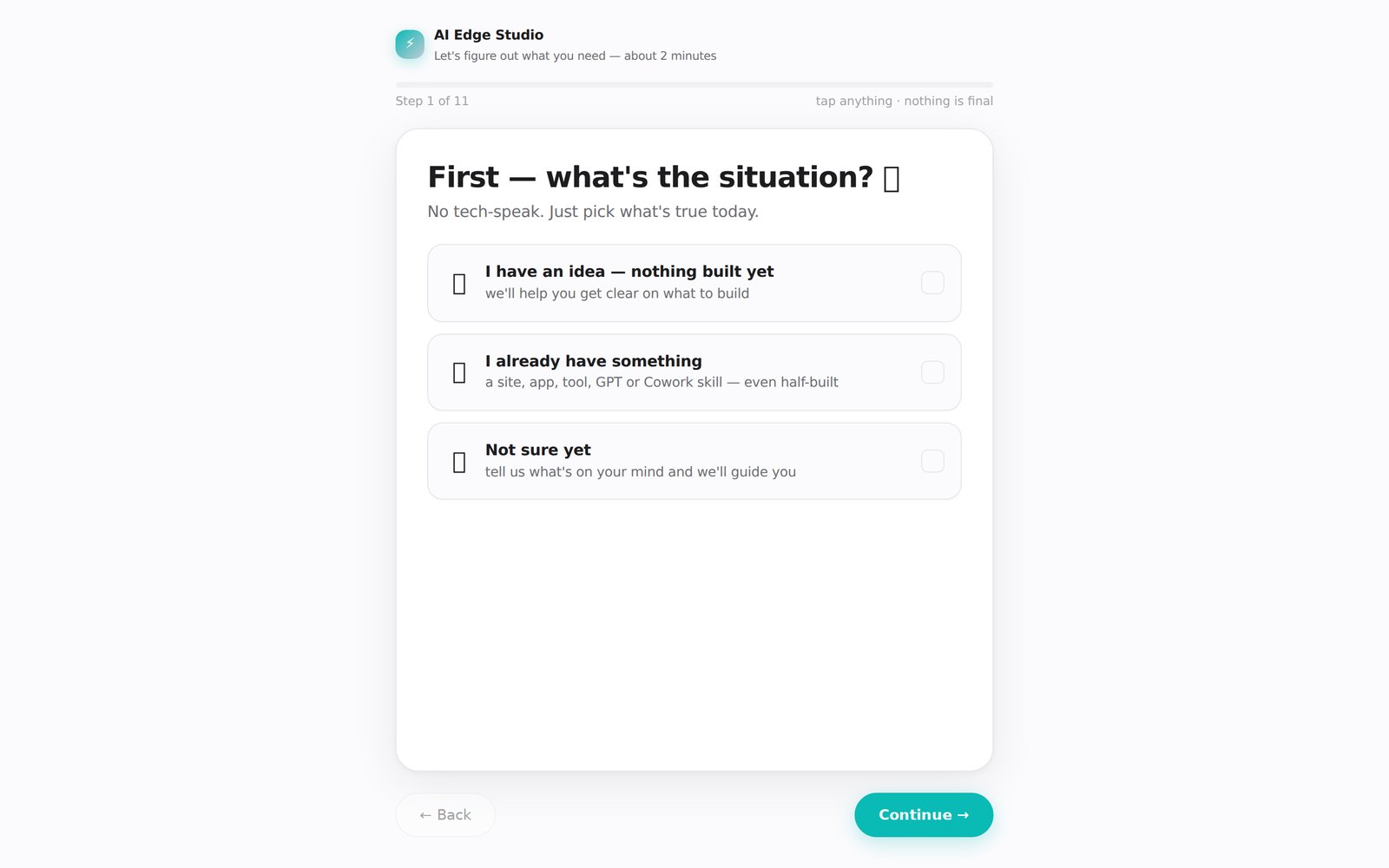
AI Edge Studio intake wizard
The intake wizard LIVE
Plain-English, 11 steps — "what's the situation?" not "describe your requirements." Try it live ›
studio.aiedge — command center
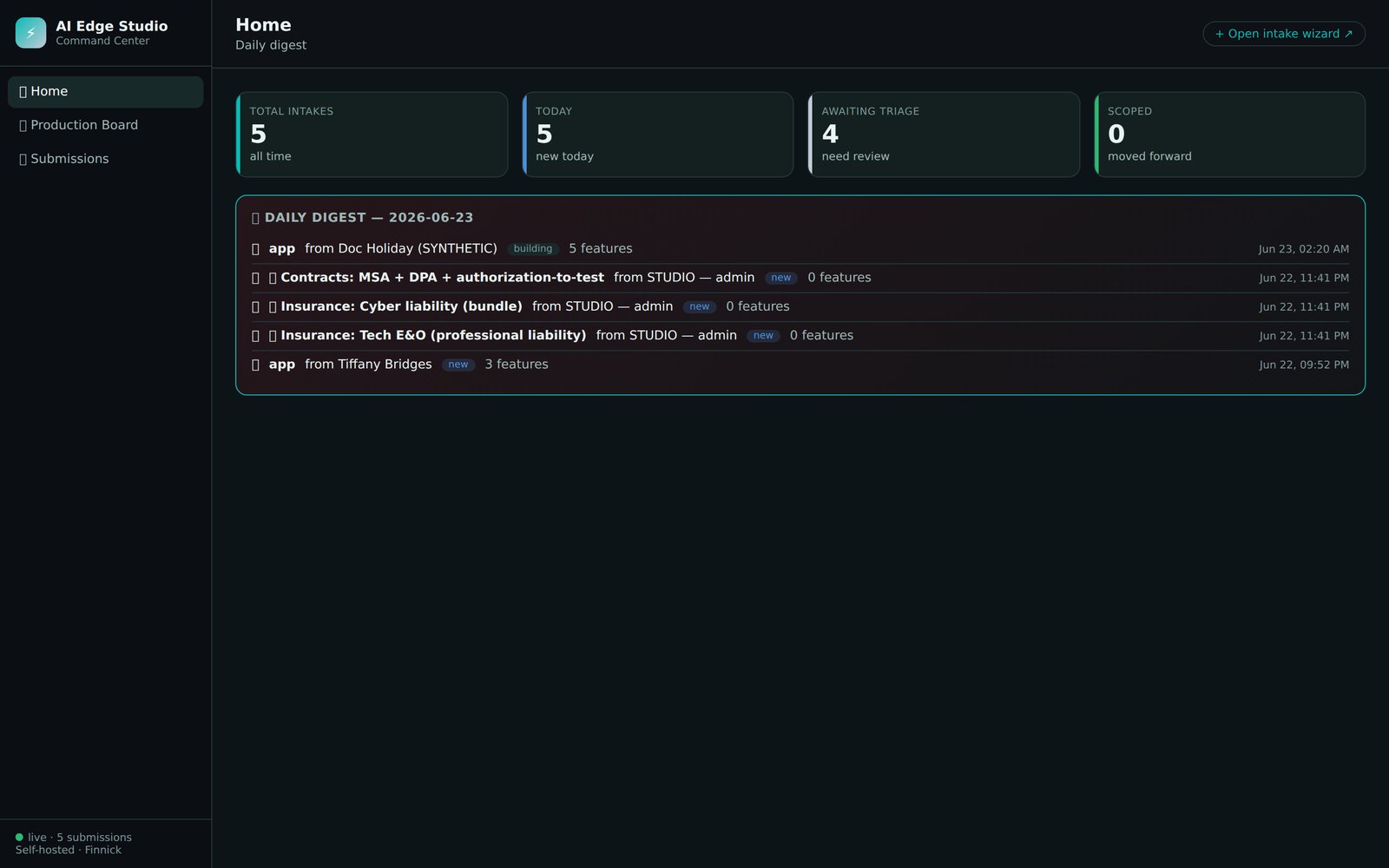
AI Edge Studio Command Center
The Command Center
Live intakes, triage queue, and scoping status — the operator's view of the funnel.
The moat

An agent-assemblable component registry

A private registry of vetted components with AI-readable metadata and recursive dependencies, so an agent assembles a new build ~80% from the catalog. Every build contributes at least one generalized component back — the library compounds with each project.

Recurring track

Build Health Monitoring

A check-engine light for your system: a scheduled re-scan of a delivered build, a delta report, and an alert when a new CVE, regression, or risk appears. The systems I build are meant to be run, not shipped and forgotten.

Have something you want built right?

Start with the 2-minute intake wizard — it scopes and prices your idea — or just email me.